Kippered Beef Steak Vs Beef Jerky
Beefiness jerky is a satisfying and healthy low-carb snack, providing a hefty dose of protein per single-ounce serving. For these reasons, information technology'southward gained quite the following amongst hard-cadre athletes and distance runners, who are ever on the sentry for an hands transportable refueling option that provides them with all the nutrients they need for muscle-building, sodium replenishment, and more — see our recommendations for best beef jerky for runners.
However, unless y'all've e'er attempted to make your own beef jerky, you may accept never considered which parts of the cow nowadays the all-time cuts of beef for turning out this pop snack-pantry staple. That'southward where this commodity comes in. We're here to tell yous everything you need to know about the different beef cuts, in which sections of the cow they can be found, and why some make better choices for beef jerky than others.
Mutual Elements of Standout Beef Jerky
When you bite into a strip of high-quality beef jerky, you can tell right away. The texture is appealingly chewy without being too tough, there are just trace amounts of fatty (if any at all), and the season hits your sense of taste buds in all the right spots. Conversely, you're probable to notice if the beefiness is of poor quality—for example, if the meat isn't tender or flavorful plenty to entice you lot into taking a 2d bite.
Properly seasoned beef jerky must contain enough of salt, or sodium-laden products such every bit soy sauce. Table salt is a hygroscopic substance, meaning that it has the innate ability to describe excess moisture out of the meat, thereby speeding upwards the drying procedure. Information technology goes without proverb that this also makes the strips of beef more flavorful, and helps distance runners to furnish their depleted sodium levels.
Since fatty is incapable of drying out every bit thoroughly as flesh, it'south advisable to use the leanest cuts of beef possible when making beef hasty. Too much fat can contribute an unappealingly stringy texture to your finished production. Since it doesn't fully dehydrate, it's as well more decumbent to spoilage, pregnant the hasty won't terminal equally long at room temperature.
Breaking Downwardly the Cow
In society to sympathise what makes certain cuts of meat more suited for the task of jerky-making than others, information technology'southward best to first take a look at the parts of the steer that are generally used for roasts, steaks, and basis meat products. At the top of each section, we'll rank the section on a scale of 1 (if the portion is unsuitable for beef hasty) to v (for the cuts that are probable to make the best jerky). Note that these names are used primarily in the United States and Canada—other areas of the world may use other names, or even butcher the meat differently.
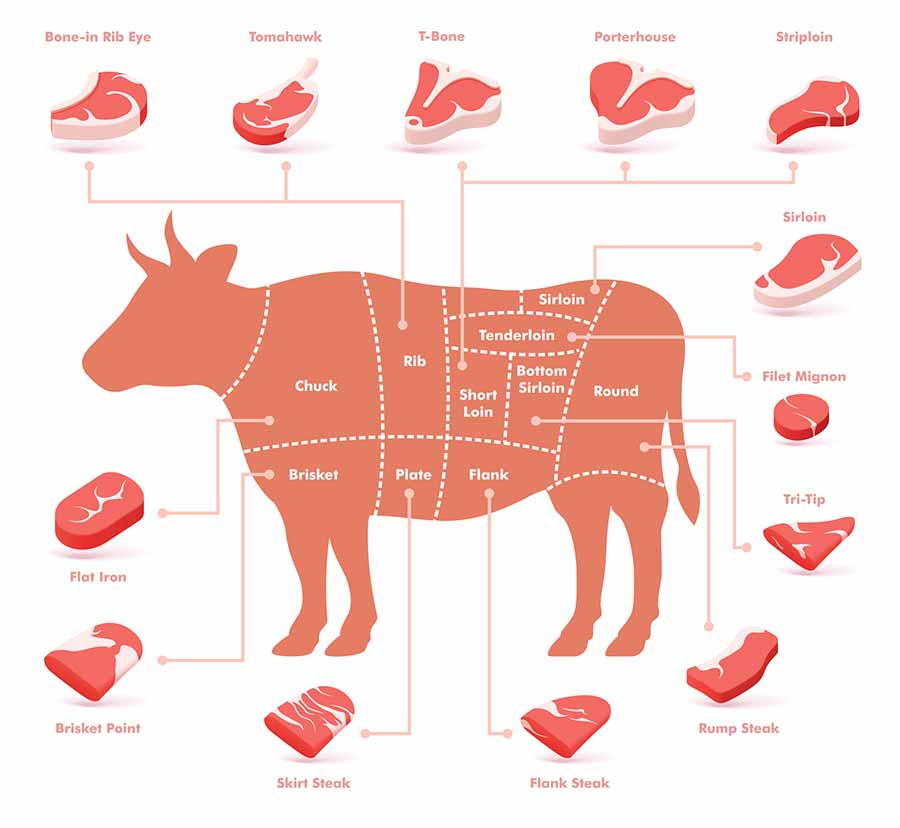
#ane – Chuck
Jerky Suitability Cistron: iii
The chuck portion is located around the top shoulder of the animal, and the meat is used primarily for either bone-in or boneless steaks and roasts. One cut, the shoulder petite steak or "teres major," is so popular on eatery menus that information technology'southward earned the nickname "bistro steak." Sometimes the trimmings (the small pieces that are cutting away) are often ground into meat for hamburger, at which time it's labeled as "ground chuck."
While chuck steaks and roasts are suitable for making jerky, information technology can be time-consuming to trim all of the excess fat from the meat beforehand. Additionally, the loftier-fat content means that the jerky won't stay fresh for as long. That's why we've given information technology a mediocre ranking on the suitability scale.
#2 – Brisket
Jerky Suitability Factor: 3
Beef brisket is a well-marbled cutting that'southward often used for barbecue, pastrami, and corned beef. Its fibroid grain makes it ideal for long cooking at low temperatures, both of which tin be used to describe the jerky-making process. Before butchering, the brisket is located only under the chuck, below the fauna'southward shoulder section.
Like the chuck section, the brisket contains backlog fat, and is therefore more prone to spoilage than some of the higher-ranked cuts. The jerky volition taste fine, but it requires a high level of prep fourth dimension for a product that's ultimately more perishable.
#3 – Rib
Hasty Suitability Factor: ane
The rib department contains 2 of the almost prized cuts of meat for steak lovers—the prime number rib and the rib eye. Beef curt ribs, which are both meaty and flavorful when prepared correctly, are also sometimes taken from this section (located but backside the chuck, toward the rear of the moo-cow).
Because the meat from the rib is both fine-grained and fatty, information technology's really not a suitable option for beef jerky. While the marbling lends a ton of flavor to the rib eye steak and other cuts, it doesn't translate as well when you're trying to ready thin strips for the dehydrator. The fine texture doesn't hold upward well to the drying process, either, which tin can make for a crumbly product.
#four – Plate
Hasty Suitability Factor: 2
This portion—found on the underbelly of the cow—is also used for beef short ribs, also equally pot roasts. Brim steaks, the cut of choice for fajitas, tin be found here equally well. The trimmings are typically ground into hamburger.
While the chewy texture of skirt steak tin make for an highly-seasoned jerky, meat from the plate section is generally too tough and fat for the dehydrator. It can be used in a pinch, merely if yous accept other options, you should consider one of those instead.
#five – Brusque Loin
Jerky Suitability Gene: 4
Another center section, this one located just behind the rib, the brusque loin is used for porterhouse and T-os steaks (information technology'southward intersected by the tenderloin; see clarification below). The meat is very tender, and while there's some marbling (streaks of fat in the meat), it's typically like shooting fish in a barrel to piece of work around. This makes it a fine choice for beef jerky if you lot can beget a slightly higher price tag.
#half dozen – Flank
Jerky Suitability Factor: 5
This steak is quite popular for grilling, as the coarse texture gives way to a tender bite when the steak is thinly sliced against the grain. The flank is located toward the beast'due south rear legs, beneath the loin sections.
Flank steak has a assuming, compact flavor all its ain, but holds up exceptionally well to marinades, which makes information technology a great choice for jerky. Every bit with cuts from the short loin, the simply drawback is the price, which can be prohibitive if y'all're making a large batch.
#7 – Sirloin, Top Sirloin, and Bottom Sirloin
Jerky Suitability Cistron: 4
These sirloin and meridian sirloin portions—intersected by the tenderloin—can be found forth the top rear area of the cow. The bottom sirloin rests beneath the top sirloin, merely above the flank. Steaks from this segment are both pop and easy to find, and roasts made from this section are both tender and flavorful—a winning combination.
While there is an outer layer of fatty on sirloin steaks, it tin be trimmed away hands, and the residue of the meat contains very piddling marbling. It loses a point on the suitability ranking only because it's pricier than cuts from the round. Otherwise, it'south a great choice.
#8 – Tenderloin
Jerky Suitability Cistron: three
Equally the name suggests, tenderloin provides the nigh tender cuts of all, including filet mignon, chateaubriand, and tournedos. It'south a long, narrow segment that segments the sirloin and top sirloin sections, with its thicker section pointing toward the rear of the cow.
This cut is very lean, and will event in some of the most tender jerky you'll e'er sample—excessively tender, in our opinion. The meat doesn't have marinades well, and even when it's dried, its texture is as well soft to plow out a satisfying product. Another strike against it is the cost, which is far too high to recommend the tenderloin for jerky production.
#9 – Circular
Jerky Suitability Factor: v
The round is located in the rear of the cow, also known as the "rump" department. The meat is lean, with an easily detectable grain that tin can be sliced accordingly—with the grain for a chewier texture, against if y'all adopt a more tender bite.
Eye of the round is an excellent choice for beefiness jerky. Not merely is it well-suited to marinades, it'south also very reasonably priced, which is one of the near important considerations since the meat loses a good deal of its weight during the dehydration procedure. Accordingly, eye of the round is the cut from which most commercially prepared jerky is made.
#10 – Shank
Jerky Suitability Cistron: 1
Shanks are the upper portions of the leg, establish only beneath the brisket and round sections. Meat from the shank is traditionally used for stews and other braises, as it's too tough to be prepared whatsoever other style. For this reason, it's all-time to steer articulate of this section if you lot're hoping to make jerky that takes less than a twenty-four hours to chew through.
Sale Bestseller

Upgraded ane.57LB Chapters Stainless Steel Jerky Gun Sausage...
- Our jerky maker gun comes equipped with nutrient...
- Like shooting fish in a barrel to Make & Easier to Clean: Our jerky gun...
- Various Jerky Nozzles & Cleaning Brushes: Our...
- Bask Our Hasty Gun Kit: Our hasty gun is...
- 【100% Satisfaction Guarantee】Axansiho is...
Decision
I hope you've enjoyed the article, only if you're more of a visual person, the below video will exist helpful.
Last update on 2022-06-05
QUOTE:
"You lot might be a redneck if y'all think that beefiness hasty and moon pies are two of the major food groups."
-- Jeff Foxworthy
Source: https://beefjerkyhub.com/best-cuts-of-beef-for-jerky
0 Response to "Kippered Beef Steak Vs Beef Jerky"
Post a Comment